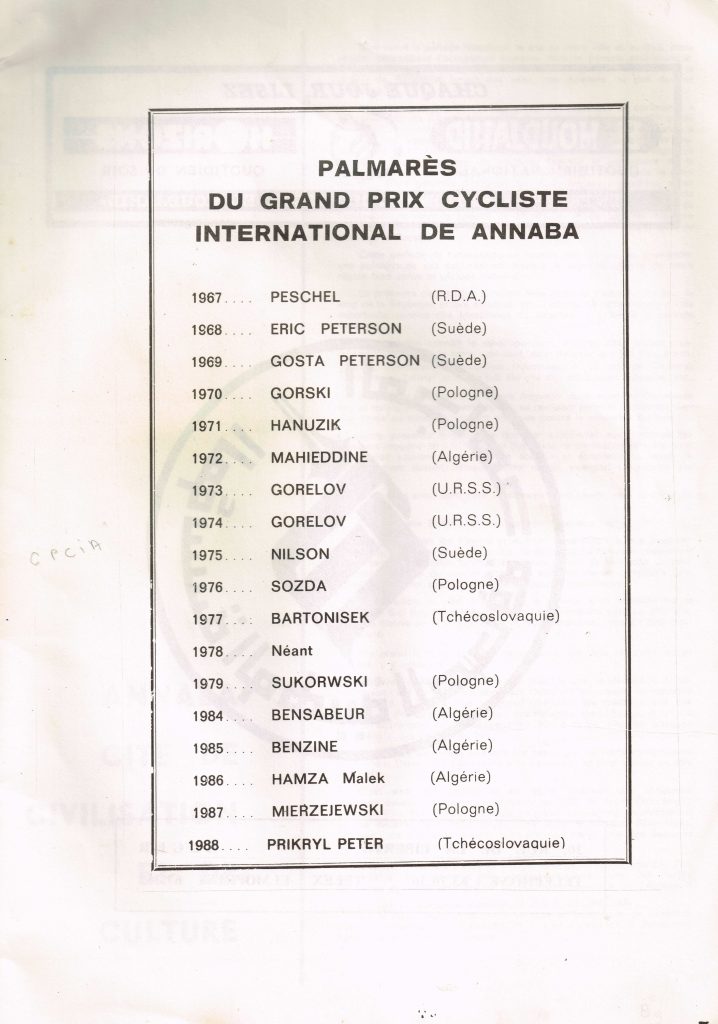
Grand Prix Cycliste International of Annaba (1967)
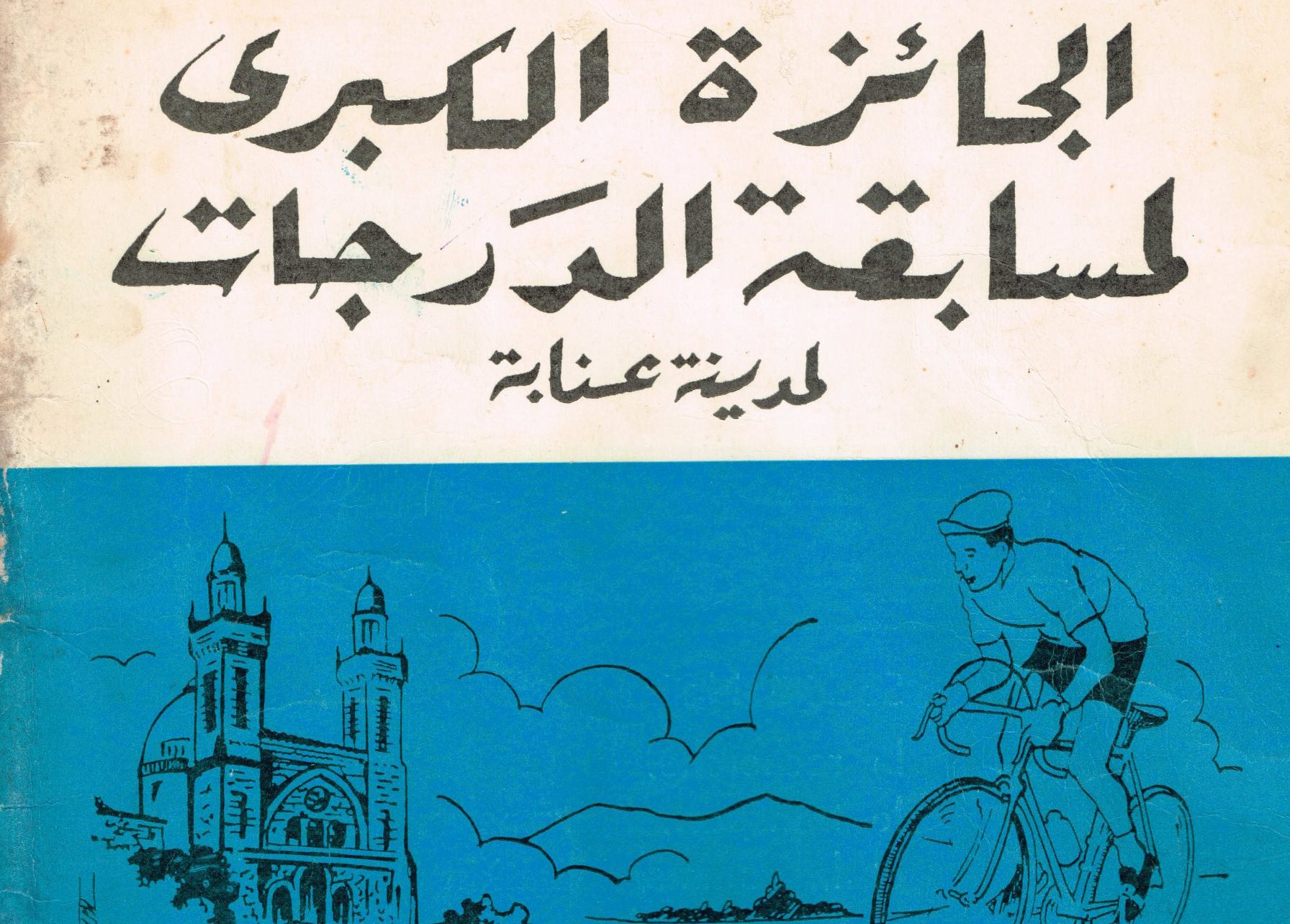
The Grand Prix d’Annaba was launched in 1967, becoming the first major international cycling event organized in independent Algeria. Riders from Europe and the Arab world competed across varied landscapes—mountains, coastlines, and urban stretches—making it a demanding and prestigious race.
Although international riders dominated early editions, Algerian cyclist Kaddour Mahieddine secured a historic win in 1972, followed by other local champions who marked Algeria’s rise in competitive cycling.
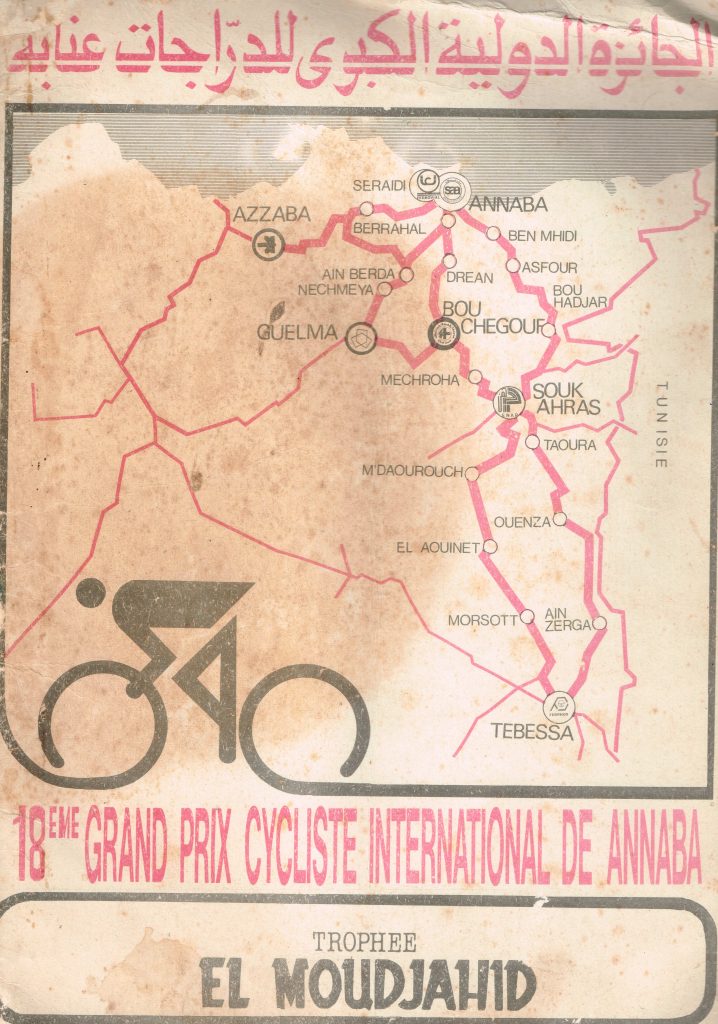
In March 1968, the Algerian city of Annaba hosted one of the most ambitious and professionally organized cycling races in North Africa: the 2nd Grand Prix Cycliste International de la Ville d’Annaba. This multi-stage race marked a turning point in post-independence Algeria, showcasing the country’s growing capacity to host high-level international sporting events under the supervision of the Algerian Cycling Federation (FAC) and in line with the regulations of the Fédération Internationale Amateur de Cyclisme (FIAC).
Race Overview: 10 Stages – 1441 Kilometers of Pure Challenge
The event was held from March 15 to March 24, 1968, and included 10 stages, one of which was an individual time trial. The race stretched over 1,441 kilometers, passing through several major cities in eastern Algeria and combining flat routes, mountainous climbs, and urban circuits.
| Date | Stage | Major Climbs (Col) | Distance (km) |
| 15/3 | Annaba – Constantine (via Guelma and Oued-Zenati) | Fedjouj (3rd), Ras El Akba (2nd) | 171 |
| 16/3 | Constantine – Setif (via Djemila) | Djemila (1st) | 185 |
| 17/3 | Setif – Batna (via Ras El Aioun) | Tadmout (1st) | 155 |
| 18/3 | Batna – Skikda | El Kantour (1st) | 158 |
| 19/3 | Skikda – Annaba (via Azzaba and Guelilène) | Bissy (1st), Fedjouj (2nd), Guelilène (3rd) | 152 |
| 20/3 | Rest Day in Annaba | — | — |
| 21/3 | Annaba – El Kala – Annaba (round trip) | Mechroha (1st) | 208 |
| 22/3 | Annaba – Souk Ahras – Annaba (round trip) | Ain-Senour (1st) | 210 |
| 23/3 | Tour of the Annaba Plains (Individual Time Trial) | — | 67 |
| 24/3 (morning) | Annaba – Bouzizi | Seraïdi (1st), Bouzizi (1st) | 80 |
| 24/3 (afternoon) | Urban circuit in Annaba | — | 20 |
Participation Regulations and Organization
- The race was open to teams of 6 amateur riders with valid licenses from a FIAC-affiliated national federation.
- Each delegation could include up to 9 persons: 6 riders, 1 technical director, 1 mechanic, and 1 physiotherapist.
- Parental authorization was required for minor riders.
- The use of yellow, orange, and white jerseys was prohibited to avoid confusion with leader jerseys.
- The deadline for federation applications was February 15, 1968. Final registrations were due by February 25.
The event was organized by the Union Sportive Musulmane d’Annaba (USMA), with logistical coordination managed from 18 Rue Cheikh Larbi Tebessi in Annaba.
An Event of International Scale
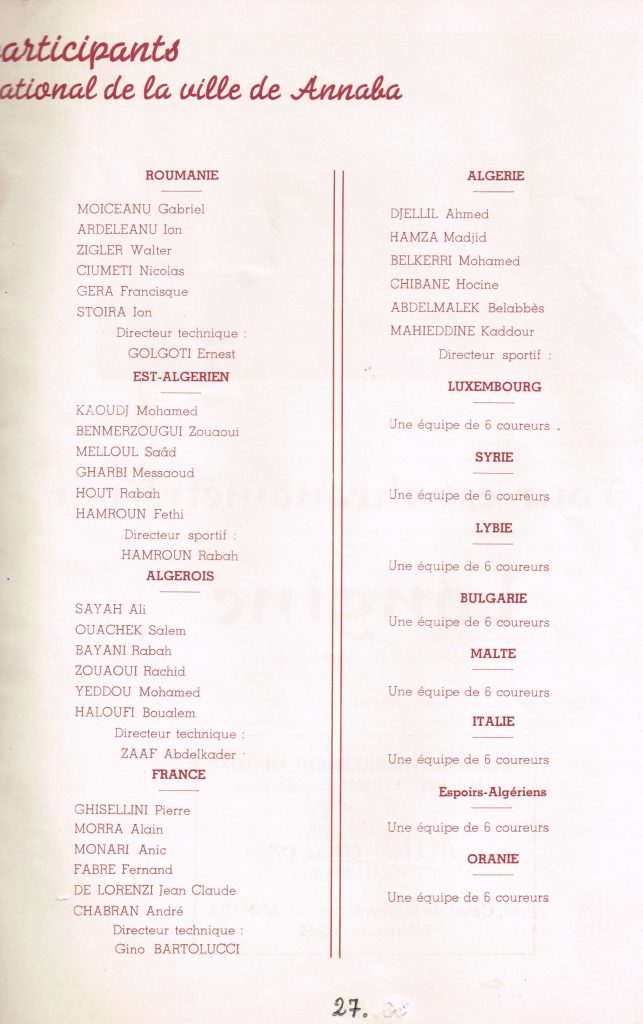
This edition of the Grand Prix was not just a national race — it was a highly international competition, drawing participation from several countries and cementing Annaba’s reputation as a capable host city. The diversity of terrain (mountains, coastlines, and urban centers) made it an ideal test of endurance, strategy, and teamwork.
The inclusion of high-altitude mountain passes such as Seraïdi, Djemila, and El Kantour added a European-level technical dimension, offering a true challenge even for experienced riders.
Legacy and Significance
The 1968 edition stands out as one of the most structured and comprehensive cycling races in Algeria’s early independence years. With meticulous planning, multi-stage logistics, and adherence to international standards, it represented Algeria’s emerging organizational strength in the world of sports.
Although the Grand Prix was later discontinued in the late 1980s, its memory remains alive among cycling enthusiasts. With the current revival of interest in cycling and active mobility in Algeria, especially in cities like Annaba, calls for reviving this historic race are growing louder.
Conclusion
The 1968 Grand Prix Cycliste International of Annaba was more than a race — it was a symbol of ambition, unity, and excellence in post-colonial Algeria. It proved that Algerian cities could not only compete but also host major international sports events with professionalism and pride. Today, its legacy inspires a new generation of cyclists, urban planners, and sports promoters who dream of putting Annaba back on the international cycling map.